2026 How to Choose a Hinged Knee Brace Supplier
Choosing a Hinged Knee Brace supplier in 2026 is more than comparing unit prices. Buyers need evidence that products are consistent, traceable, and suited to their intended users. The demand context is substantial. The World Health Organization’s 2023 osteoarthritis fact sheet reports that 528 million people lived with osteoarthritis in 2019, including 365 million with knee osteoarthritis. These figures describe health needs, not brace sales. Still, they show why dependable product sourcing matters.
A supplier review should examine hinge strength, strap adjustment, material durability, sizing accuracy, and documented quality controls. Ask for product specifications, inspection records, and clear instructions for fitting and care. Request samples, then check how smoothly each hinge moves and whether straps stay secure during repeated use. Small details matter. A poorly placed seam can rub against skin; unclear sizing can create avoidable returns. These checks do not replace clinical judgment, but they help buyers assess manufacturing reliability.
Experience also means looking beyond a polished catalogue. Compare lead times, communication, customization limits, and procedures for handling defects. Confirm which standards or certifications apply to the specific product, and verify supporting documents rather than relying on broad claims. The WHO’s 2022 report on musculoskeletal conditions emphasizes the wide global burden, but it does not identify one best brace design or supplier. That distinction is easy to miss. No checklist guarantees a perfect partnership, and buyers should revisit performance after delivery. This guide outlines practical questions for evaluating a Hinged Knee Brace supplier with evidence, care, and realistic expectations.
Define Your Hinged Knee Brace Requirements and Intended Use
Before contacting a hinged knee brace supplier, define who will wear the brace and what support is needed. A brace for everyday walking may require different features from one used during sport or recovery. Write down the wearer’s activity level, expected wear time, and any clinician-recommended limits on knee movement. Keep it concrete. “Several hours at work” is more useful than “regular use.”
Consider the wearer’s leg measurements, clothing, and ability to adjust straps without help. For example, swelling can change fit during the day, while bulky hinges may press against a desk or car seat. Ask whether the supplier offers clear sizing guidance, replacement parts, and fitting instructions. Do not assume every hinged design provides the same stability or range-of-motion control. A hinge is only one part of the brace.
Share these requirements when comparing suppliers, and ask how products are checked for fit, function, and material quality. Confirm whether the brace can be adjusted to the prescribed settings, if applicable. Check return and exchange terms before ordering; a size chart cannot predict every fit issue. It is easy to overlook comfort. Yet a brace that rubs behind the knee may not be worn consistently. If the intended use or movement limits are unclear, ask a qualified health professional before choosing a model.
2026 How to Choose a Hinged Knee Brace Supplier: Define Your Requirements and Intended Use
Use this illustrative 1–5 planning scale to compare requirements before evaluating suppliers. Priorities vary by wearer and application; confirm fit, hinge range-of-motion settings, and suitability with a qualified clinician when the brace is for an injury or rehabilitation.
Assess Product Quality, Materials, Fit, and Safety Standards
2026 How to Choose a Hinged Knee Brace Supplier
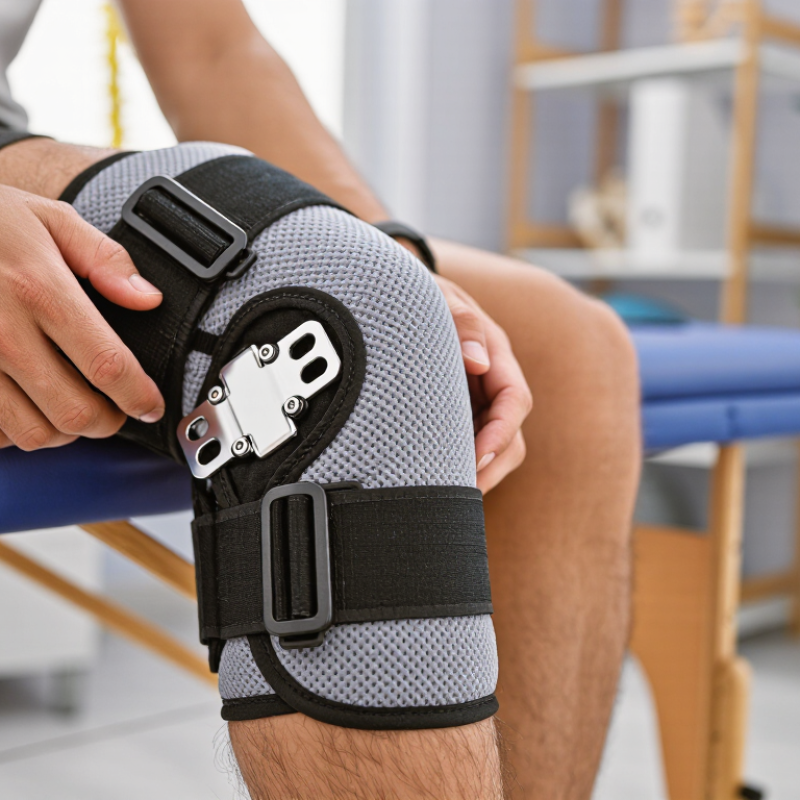
A reliable supplier should explain how each brace is made, tested, and fitted. Ask for material specifications, inspection records, and clear sizing guidance—not just a polished catalogue. Check the hinges. They should move smoothly, resist wobbling, and sit level with the knee joint when the brace is worn. Uneven alignment can create pressure behind the knee or make movement feel awkward.
Materials affect comfort and durability. Look for sturdy hinge components, reinforced stitching, and a lining that feels soft against the skin. Ask how the brace handles sweat, repeated flexing, and routine cleaning. If possible, inspect a sample after adjusting its straps; hook-and-loop fasteners should grip firmly without curling at the edges. Fit matters. A brace that slips during a short walk may need different sizing or strap placement, even if its measurements match the chart.
Safety claims deserve careful checking. Request relevant test reports and documentation showing which quality or product standards apply in the intended market. Confirm that instructions cover fitting, adjustment, cleaning, and signs of wear. A supplier should explain limitations plainly and avoid promising that one brace suits every injury. One detail is easy to overlook: ask whether replacement parts, such as straps or hinge components, are available. Specs can look convincing, but the brace’s feel and fit may still need a second look.
Compare Supplier Manufacturing, Customization, and Delivery Capabilities
A reliable hinged knee brace supplier should be assessed by how consistently it can build the brace, adapt it, and deliver it. Ask how hinges are attached and checked, and whether staff inspect stitching, strap placement, and range-of-motion settings. Small details matter. A loose hinge cover or uneven hook-and-loop strap can affect comfort after repeated use. Request a production sample, then compare it with the written specifications.
Customization should be specific, not just a promise to “meet your needs.” Confirm available sizes, hinge options, fabric choices, logo placement, and packaging changes. Ask which adjustments require new tooling or a minimum order, and request a drawing or sample before approving a change. A sample can feel reassuring, but it does not prove every production run will match. Ask for evidence. Inspection records and a clear process for handling defects are more useful than broad quality claims.
Delivery capability deserves the same scrutiny as manufacturing. Request realistic lead times for samples, first orders, and repeat orders, plus updates if materials are delayed. Check how the supplier packs braces to prevent bent hinges or crushed cartons in transit. If your forecast changes often, ask how quickly they can confirm revised quantities. There may be gaps between a supplier’s stated schedule and actual dispatch; track a trial order and note where communication or timing falls short.
Review Pricing, Documentation, Warranty, and Customer Support
When comparing hinged knee brace suppliers, request a written quote showing unit price, minimum order, sample fees, freight, and replacement-part costs. Confirm whether sizing or packaging changes affect the price. A low quote can hide recurring costs. Check the lead time and payment terms, too.
Ask for product specifications, material details, fitting and cleaning instructions, and test records relevant to the brace’s intended use. Request batch or lot identification so delivered products can be matched to their records. Small gaps matter. Documentation should be clear enough for staff to use without repeated clarification.
Read the warranty closely. Check its duration, covered components, exclusions, and claim process; straps may wear differently from hinges. Also test customer support before ordering: send a specific question about sizing or a damaged component and note the response time.
WHO and UNICEF’s 2022 Global Report on Assistive Technology estimates that 2.5 billion people need one or more assistive products, with that number projected to reach 3.5 billion by 2050. This is not a knee-brace market estimate, but it highlights the importance of dependable access and service.
A long warranty alone does not prove quality; practical support may matter more.
Verify Supplier Credentials and Test Samples Before Ordering
Before ordering a hinged knee brace, check who is actually making it. Ask for the supplier’s registered business details, manufacturing address, and quality-system documents. Confirm that certificates are current and cover the relevant facility and product scope. A polished document folder is reassuring, but it cannot prove that every production batch will match.
Request samples from the same materials and process planned for your order. Inspect the hinge alignment, strap stitching, edge finishing, and size labels under good light. Then try the brace through repeated bending and straightening, checking for slipping, pinching, or uneven resistance. Small details count. Record the size, test conditions, and any defects, so feedback stays specific rather than subjective.
Ask how the supplier tracks lots, handles rejected units, and controls changes to fabric, hinges, or suppliers. Compare a pre-production sample with the approved sample before authorizing a larger run. If the sample feels comfortable once, that is useful—but not enough. Fit can vary across users, and a short test may miss wear or durability issues. Be clear about what you have not tested, and consider a small pilot order before committing to volume.