Leave Your Message

China Best Casting Tape Supplier for Global Buyers?

Choosing the right China-based Casting Tape supplier takes more than comparing prices. Buyers need evidence that each roll performs consistently, from the first wrap to the final trim. A carton arriving on time is useful. A carton with uneven resin, loose fiberglass strands, or unclear batch identification is not.

Quality-management expert W. Edwards Deming is often quoted as saying, “Quality is everyone’s responsibility.” His principle is not specific to casting tape, but it applies directly to supplier evaluation. Ask how the factory checks resin coating, curing time, roll length, packaging integrity, and lot traceability. Request current product specifications and samples, then assess them under realistic storage and handling conditions. Small details matter: a crushed box corner or a label that smudges can complicate receiving and inventory checks.

Price still matters. So do production capacity, lead-time accuracy, communication, and export documentation. Yet a polished brochure cannot replace consistent records or clear answers when a sample fails. That is where buyers should look closely. Even a thorough audit has limits; one visit cannot guarantee every future batch. Keep that in mind, and compare suppliers using the same requirements rather than promises alone. A dependable partner should explain what it can verify, what it cannot, and how it handles problems. For global buyers, that practical honesty may be as valuable as a low quote.
China Best Casting Tape Supplier for Global Buyers?

Market Context: WHO Estimates 1.71 Billion People Live with Musculoskeletal Conditions

WHO estimates that 1.71 billion people live with musculoskeletal conditions worldwide. These conditions affect bones, joints, and muscles, and can make ordinary tasks difficult. A painful wrist can complicate dressing; a leg injury can limit a commute. The figure is sobering. It does not mean every affected person needs a cast, but it highlights the scale of care needs across very different settings.

Casting tape has a specific role: supporting immobilization when a qualified clinician considers it appropriate. For global buyers, supplier evaluation should go beyond price. Consistent product dimensions, clear instructions, reliable packaging, and documented quality checks help clinicians use materials with greater confidence. Delivery reliability also matters, especially where clinics maintain limited stock. Details can be easy to overlook.

A supplier cannot address the causes of musculoskeletal conditions or replace clinical judgment. Still, dependable materials can support treatment workflows. Buyers can ask about batch traceability, storage conditions, shelf life, and available sizes, then assess samples against their clinical requirements. One weakness in procurement is assuming that a product performs identically in every setting. Water access, staff training, and local handling practices may differ, so practical evaluation matters.
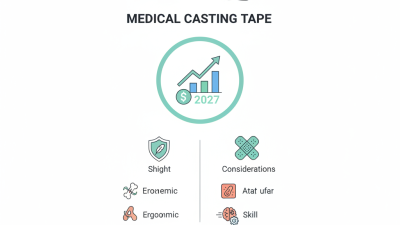

Musculoskeletal Conditions Affect 1.71 Billion People Worldwide

A global health context for buyers evaluating casting and orthopedic products.

The World Health Organization estimates that 1.71 billion people live with musculoskeletal conditions. This broad estimate indicates the scale of global need; it does not represent the number of people who require casting tape.

Product Basics: Fiberglass and Polyester Casting Tape Materials

Fiberglass casting tape uses glass filaments woven into a porous carrier, while polyester versions use PET textile. ASM International materials references place E-glass density near 2.5 g/cm³ and PET fiber near 1.38 g/cm³. These figures describe the fibers, not a finished roll. Resin loading, weave, and tape width also affect weight and handling. Small detail. It matters.

Buyers should compare cured strength, working time, and water activation—not just the fiber name. ASTM D3776 measures fabric mass per unit area, and ASTM D5035 tests textile breaking strength. These methods help suppliers present comparable material data, though they do not assess a complete cast in clinical use. A dense weave may feel more stable around a wrist, while an open weave can help resin wet the tape evenly. Still, lighter fiber does not guarantee a lighter or more comfortable finished cast. Ask for technical data measured on the actual tape, and check whether the figures describe dry fabric or resin-coated product. That distinction is easy to miss.

Performance Benchmarks: Common 3–5-Minute Working Time and 20–30-Minute Setting

For buyers comparing casting tape suppliers, working time and setting time are practical benchmarks, not universal promises. Many products allow roughly 3–5 minutes of workable time after activation, with initial setting commonly taking 20–30 minutes. It moves fast.

During application, a technician may wet the roll, remove excess water, and smooth each layer before the material firms. Cooler water or a cool room may slow the reaction; warmer water may shorten the handling window. Keep tools ready. Delays between dipping and molding can leave less time for shaping, especially around joints or uneven contours. Check these ranges against the supplier’s technical data and confirm them with a sample under local conditions.

“Setting” does not necessarily mean full strength or readiness for every next step. Ask how the supplier measures both times, including water temperature, test method, and layer count. A stopwatch helps, but it cannot fix inconsistent technique. One awkward point: published figures can look precise while actual application conditions vary. Compare repeatable trials, not one fast demonstration, and record when the tape becomes difficult to mold and when it holds its shape.

Quality Verification: ISO 13485:2016 and the ISO 10993 Biocompatibility Series

For global buyers, a casting tape supplier’s quality claims deserve a practical check. ISO 13485:2016 sets requirements for a medical-device quality management system; it does not guarantee that every roll performs well. Request the certificate and verify its validity, covered site, and scope. Then compare these details with the facility making the tape. Small detail. A certificate for another location may leave an important gap.

The ISO 10993 series supports biological evaluation, but testing should reflect how a material contacts the body and for how long. Ask for relevant reports, the tested material’s identification, and evidence that samples represent current production. A report for a different resin, pigment, or adhesive may not fit. Not every test applies to every product. A clear rationale matters.

Check whether lot records connect incoming materials, production dates, and finished rolls. If a formulation or process changes, ask how the supplier reviews its biological evaluation and quality documents. Paperwork alone is not enough. It can be tempting to treat a certificate as a shortcut, and buyers sometimes do. Yet a focused review of scope, test relevance, and traceability gives a more dependable picture.

China Best Casting Tape Supplier for Global Buyers? — Quality Verification: ISO 13485:2016 and the ISO 10993 Biocompatibility Series
Verification Dimension Relevant Standard or Evidence What Buyers Should Check How to Interpret It
Medical-device quality management system ISO 13485:2016 Request a current certificate and confirm the certified legal entity, manufacturing site, product-related scope, issuing certification body, and validity dates. ISO 13485 specifies requirements for a medical-device quality management system. Certification does not, by itself, prove that every product is approved for sale in every market or that a particular casting tape meets all product requirements.
Certificate authenticity and scope Certificate and certification-body records Verify the certificate directly with its issuer. Check that the site producing the tape is included and that the scope is relevant to the supplied medical device or manufacturing activity. A certificate for a different site, entity, or unrelated scope is not sufficient evidence for the product being purchased. Confirm any applicable accreditation and certificate status through reliable records.
Production and batch controls ISO 13485:2016 quality-system records Ask how the supplier controls incoming materials, production records, product identification, traceability, nonconforming product, and changes to materials or processes. Request a representative batch record or quality-document example where available. These controls help establish consistency and traceability. Their existence should be assessed through documented evidence and, where appropriate, an audit—not inferred from a certificate alone.
Biological evaluation planning ISO 10993-1 Request the biological evaluation rationale for the finished device, including its intended use, body-contact type, contact duration, relevant materials, and any applicable biological endpoints. ISO 10993-1 provides a framework for biological evaluation within risk management. The evaluation should reflect the actual product and intended contact; a generic statement that a product is “ISO 10993 compliant” is not a complete assessment.
Cytotoxicity ISO 10993-5 Review the test report or justified assessment for the relevant finished product or representative samples, including the tested sample, method, laboratory, and conclusion. ISO 10993-5 addresses in vitro cytotoxicity testing. Whether testing is needed and how results are interpreted depend on the biological evaluation plan and product-specific risk assessment.
Skin sensitization ISO 10993-10 Check whether sensitization has been addressed for materials that may contact the patient, and review the supporting report or documented scientific justification. ISO 10993-10 addresses tests for skin sensitization. A report should identify the tested material and be relevant to the supplied product and its intended use.
Skin irritation ISO 10993-23 Review the irritation assessment and confirm that the sample preparation and exposure conditions are relevant to the product’s intended contact. ISO 10993-23 addresses tests for irritation. The appropriate evaluation depends on the nature and duration of contact and the overall biological risk assessment.
Chemical characterization ISO 10993-18 Where relevant to the risk assessment, request information on material composition, chemical characterization, and the rationale for evaluating substances that could be released from the device. ISO 10993-18 covers chemical characterization of medical-device materials. Chemical data support biological evaluation but do not, on their own, establish overall biocompatibility.
Systemic toxicity assessment ISO 10993-11 Ask whether systemic toxicity endpoints have been considered and request the supporting test data or rationale if they are relevant to the device’s contact and risk profile. ISO 10993-11 addresses tests for systemic toxicity. The need for testing should be determined by the biological evaluation, not assumed to be identical for all casting tapes.
Test-report relevance Product identification and laboratory documentation Match each report to the product name or specification, material formulation, manufacturing site, sample description, test method, report date, and any stated deviations. A report for a different formulation, supplier, or product configuration may not support the product being purchased. Ask the supplier to explain any differences and their impact on the evaluation.
Market-specific regulatory documentation Applicable destination-market requirements Request the documentation required for the intended destination, such as the relevant conformity or registration records, labeling information, and product technical documentation. Requirements vary by jurisdiction and device classification. ISO 13485 certification and ISO 10993 test reports do not replace market-specific regulatory obligations.
Overall supplier comparison Document review, sample assessment, and audit where appropriate Compare certificate scope and status, biological-evaluation evidence, traceability, change control, technical support, and consistency between documents and supplied samples. No supplier can be identified as “best” from a standard or certificate alone. Base selection on verified, product-specific evidence and the requirements of the intended market and use.

Supplier Selection: Compare Traceability, MOQ, Lead Time, and Export Documentation

China Best Casting Tape Supplier for Global Buyers?

A reliable casting tape supplier should make each roll traceable to its production lot. Ask for batch records, raw-material details, inspection results, and a clear process for handling defects. The World Bank’s 2023 Logistics Performance Index assessed 139 economies across six areas, including tracking and tracing and timeliness. These are useful supply-chain benchmarks, but they do not verify an individual factory. Request a sample lot record and check that its batch number matches the carton label.

MOQ and lead time need equal scrutiny. A low minimum order may suit a trial, yet confirm whether the quoted schedule includes production, inspection, and packing. UNCTAD reported that maritime trade grew 2.4% in 2023 and highlighted continuing shipping disruptions. A factory’s lead-time promise is not the same as the shipment’s arrival date. Ask for separate production and transit estimates, plus the assumptions behind them. Small detail. It matters.

For export readiness, request a document checklist before paying a deposit: commercial invoice, packing list, certificate of origin when applicable, and product or quality documents required by the destination market. Verify names, quantities, and lot numbers across the paperwork. Keep one awkward question on the list: who corrects a document error, and how quickly? The answer may reveal more than a polished quotation. Some buyers skip this check. That can cost time.